Context and Background

Share:
After adopting one of the region’s most restrictive religion laws in 2011, Kazakhstan experienced a sharp deterioration in religious freedom, including the liquidation of hundreds of religious organizations and the prosecution of both religious believers and atheists under extremism-related provisions. In response, Love Your Neighbor Community (LYN Community), beginning in 2013, initiated sustained engagement with the Kazakhstani government to understand the root causes of these restrictions and to pursue constructive, context-sensitive solutions.
Through long-term research, consultation, and relationship-building—especially from 2019 onward—LYN Community and its partners introduced a new approach grounded in Covenantal Pluralism and Cross-Cultural Religious Literacy (CCRL), implemented through multi-faith and multi-sector dialogue, training, and education.
Following the lifting of COVID-19 restrictions, LYN Community, together with local and international partners, began implementing this model more systematically through conferences, workshops, certificate courses, and train-the-trainers initiatives. From 2021 onward, both international and local monitoring organizations began to observe a measurable decline in restrictions and an increase in constructive government–religion cooperation.
In September 2025, LYN Community conducted its second religious freedom assessment trip to Kazakhstan, building on more than a decade of sustained engagement since its initial assessment in 2013. Compared to the conditions observed in 2013, the 2025 assessment documented progress in the development of religious freedom, including improved government–religious community relations, greater openness to dialogue, and increased institutional capacity to address religion-related issues through cooperation rather than control. Importantly, the delegation found that none of the religious minorities or atheist individuals who had previously faced prosecution were currently being prosecuted or held in prison. In the majority of cases observed, unregistered religious communities—particularly those from minority traditions—were gathering openly and without fear of repression. At the same time, the assessment produced a set of practical, forward-looking recommendations aimed at consolidating these gains by moving toward a model of systematic, long-term engagement.
In January 2026, LYN Community completed a deliberate transition away from project-based interventions toward building systemic infrastructure—a sustained ecosystem of research, training, and public engagement. This shift builds directly on proven outcomes in Kazakhstan, responds to explicit demand from both civil society and government partners, and offers a scalable model applicable across Eurasia and other post-communist societies facing similar challenges.
The Cross-Cultural Religious Literacy (#CCRL) certificate course for law enforcement in Kazakhstan was successfully completed in partnership LYNC – Love Your Neighbor Community and Caspian University with support from the Law Enforcement Academy under the General Prosecutor’s Office of the Republic of Kazakhstan, January 29-30, 2026. This training represented a concrete outcome of LYN Community’s long-term engagement (since 2013) in Kazakhstan and direct fulfillment of recommendations presented to the Government of Kazakhstan following the religious freedom assessment trip conducted in September 2025.
The training convened primarily senior-level officials who demonstrated a high level of discipline and engagement. Participants actively discussed current religious affairs and state–religion challenges in Kazakhstan, as well as the innovative, practice-oriented model for advancing religious freedom and social cohesion introduced by LYN Community.
The course was structured around CCRL’s three core competencies and three practical skills (https://www.tandfonline.com/…/10…/15570274.2021.1874165), developed by Chris Seiple and Dennis Hoover, and was specifically tailored to the needs of law-enforcement professionals by Wade Kusack and Yuliya Kharkova. A particular highlight was the in-person participation of U.S.-based law-enforcement practitioners Talib Shareef and Sameer Hossain, which enabled a valuable peer-to-peer exchange of professional experience.
A specially designed panel brought together religious leaders from different religious communities—alumni of LYN Community’s 2024 training programs, Journey from Central Asia to the Grand Canyon: Bridges Cultures and Exploring New Pathways: Cultivating a Shared Religious Landscape in Central Asia. The panel demonstrated the depth and maturity of their multi-faith relationships grounded in the philosophy of Covenantal Pluralism.
Through candid, practitioner-oriented dialogue with law-enforcement participants, panelists examined law-enforcement–religious relations, addressed persistent stereotypes and misunderstandings, and offered concrete, experience-based recommendations from the perspective of religious leadership to strengthen cooperation, communication, and trust in practice.
Key conversations explored:
Chaplaincy
Religious freedom and security
Religion and the role of law
The role of stereotypes
These discussions surfaced diverse perspectives and demonstrated how respectful disagreement can deepen understanding.
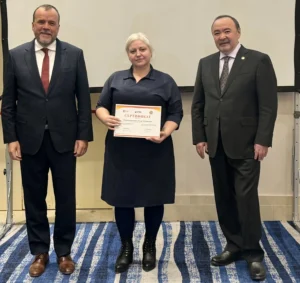 The unexpected participation of forensic professional Inna Polkovnikova—who learned about the training through a friend and requested permission to attend—highlighted the broad relevance of CCRL, demonstrating that its competencies are valuable for professionals working in multi-faith environments that require sensitive communication and cultural awareness.
Post-training evaluations reflected strong appreciation for the program and a clear demand for longer and expanded CCRL courses, especially for prosecutors.
As a key outcome, the Law Enforcement Academy and Caspian University are considering formalizing an MOU to create joint educational programs. A permanent CCRL certificate will be included in this cooperation, with LYN Community serving as the international partner and content contributor.
This marks an important next step in institutionalizing CCRL in Kazakhstan, with local academic and government partners now taking the lead in advancing the model nationally.