
Executive Summary
Strategic Significance
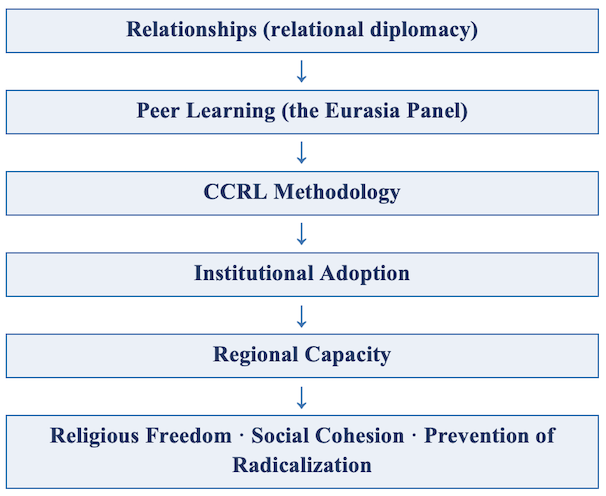
The inaugural Eurasia Panel demonstrated the viability of a permanent peer-led regional mechanism for advancing religious freedom, social cohesion, and prevention of radicalization across the post-Soviet space. It addresses the lingering Soviet legacy—patterns of mistrust, excessive state control, weak civic initiative, and limited cooperation across religious communities—through locally led collaboration rather than external pressure. Built on thirteen years of engagement, the Panel applies Covenantal Pluralism (CP) through Cross-Cultural Religious Literacy (CCRL)—practical training in evaluation, negotiation, and communication across sectors and religious difference—to strengthen regional capacity.
What Was Demonstrated
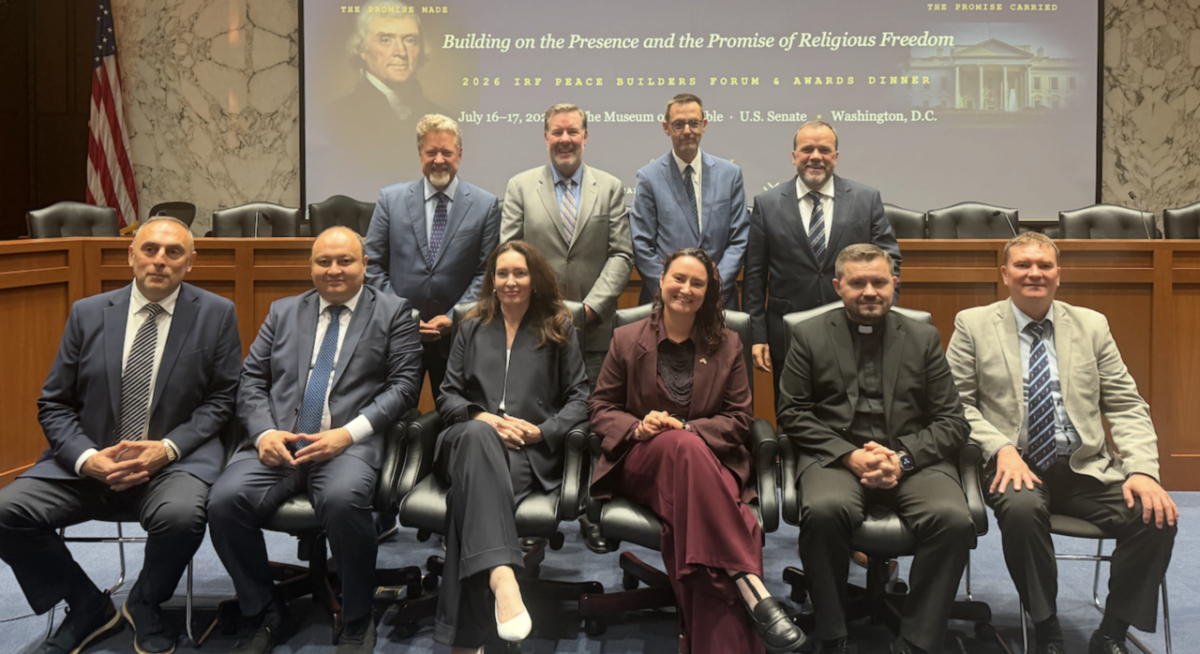
In its 105-minute inaugural session, six panelists from four implementation countries—Ukraine, Kazakhstan, Georgia, and Uzbekistan—represented three sectors (civil society, religious leadership, academia), framed by two keynote supporters from partner democracies (the Czech Republic and the United States), with Moldova participating as a consultant member at the pre-event discussions. The session confirmed that these countries have already developed transferable practices that are now being adopted across the regional network. The Panel secured senior government engagement from one implementation country—Dr. Muzaffar Kamilov, Advisor to the President of the Republic of Uzbekistan, came to honor and support the Panel—signaling official openness to continued peer learning and institutional cooperation. Panelists themselves named the Soviet legacy—mistrust, passivity, the reflex of control—and answered each with a practiced alternative from their own country’s record. Kazakhstan’s CCRL training for officials, prosecutors, and law enforcement (in three cities since 2023) yielded evaluation findings indicating a measurable shift in attitudes: many participants stopped treating religious communities as objects of control and began treating them as partners in stability—the Panel’s core outcome metric.
Institutional Outcomes
- Prague as the Panel’s standing meeting place, formally offered by Amb. Robert Rehak (Czech Republic).
- Tashkent invitation from the International Islamic Academy of Uzbekistan to host a future international religious freedom forum, plus a proposed joint roadmap for research cooperation and academic exchange.
- Kazakhstan: certified 72-hour training-of-trainers course prepared for delivery inside state professional-development systems and the law-enforcement academy — CCRL embedded within national institutions.
- Kazakhstan: the multi-faith club invited into the parliamentary working group shaping post-constitutional religious legislation.
- Ukraine: the country’s first PhD program in public theology (UETS); field-tested crisis and dialogue methodologies offered to the network.
- Georgia: commitment to CCRL-based curriculum development making religious communities “recognizable” to one another.
Together, these commitments indicate that the Panel has progressed beyond convening toward institutional adoption within government, academic, religious, and civil society systems.
Evidence of Scalability
Four countries established that independently developed practices can be exchanged, adapted, and institutionalized through a shared methodology without sacrificing local ownership. The transfer principle emerged as a research finding: the methodology—facilitated dialogue, case-based reflection, continuous evaluation—travels; content must be rebuilt around each country’s law, religious landscape, and history. One methodology functioned across four political environments; institutions of four types (an Islamic academy, a university program, a seminary, state training systems) committed to adopting or expanding it; and regional ownership was affirmed from the partner-democracy side: “we can learn a lot from you” (Amb. Rehak). The session also challenged the traditional direction of democracy assistance, showing that post-Soviet societies have developed practical approaches to rebuilding trust and social cohesion that are increasingly relevant to polarized democracies.
Next Phase
Adoption of the Panel’s charter; institutionalization through the November 2026 Prague ministerial; year-one implementation of the commitments listed above, including structured consultations in Ukraine, Moldova, and Uzbekistan; and preparation for expansion to additional post-Soviet countries. The inaugural session confirmed that the Eurasia Panel is not a conference series but an implementation mechanism—transforming successful national practices into shared regional capacity through structured peer learning and institutional partnerships—and marked its transition from concept to an operational regional platform, laying the foundation for sustained institutional implementation.
THE EURASIA PANEL
Inaugural Public Session — Report
- Theory of Change and the Inaugural Test
The central reason we created the Eurasia Panel is to overcome the lingering Soviet mentality, which remains one of the primary obstacles to advancing human rights—particularly freedom of religion or belief—across the post-Soviet region. The Panel was conceived as a trusted, peer-to-peer platform through which experts from countries sharing this historical legacy can learn from one another and jointly develop locally grounded strategies for religious freedom, social cohesion and peacebuilding, and the prevention of radicalization through responsible citizenship. Because these societies inherited similar institutional and social patterns yet have pursued distinct pathways toward religious freedom, social cohesion, and the prevention of radicalization, peer learning among them provides a uniquely credible mechanism for adapting successful reforms across national contexts. The Panel addresses the Soviet mentality not through confrontation or external pressure, but through relationships, trust, education, critical reflection, and practical cooperation. It connects regional expertise and transforms dialogue into sustained initiatives—roundtables, research, and Cross-Cultural Religious Literacy (CCRL) programs—and enables approaches proven in one country to be adapted to the particular context of another, gradually replacing inherited patterns of fear, control, and mistrust with dignity, mutual respect, freedom of conscience, and responsible citizenship.
The Panel is the fruit of thirteen years of engagement that began with a 2013 religious freedom assessment visit to Kazakhstan by LYNC and the IRF Secretariat, guided by a theory of change developed by Dr. Chris Seiple: relational diplomacy—the conviction that trust between people precedes institutional change—from which grew Covenantal Pluralism, with CCRL as its practical mechanism. On July 17, 2026, the Panel held its inaugural public session at the IRF Peace Builders Forum in Washington, D.C. This report summarizes what took place and what it demonstrated.
The Inaugural Session
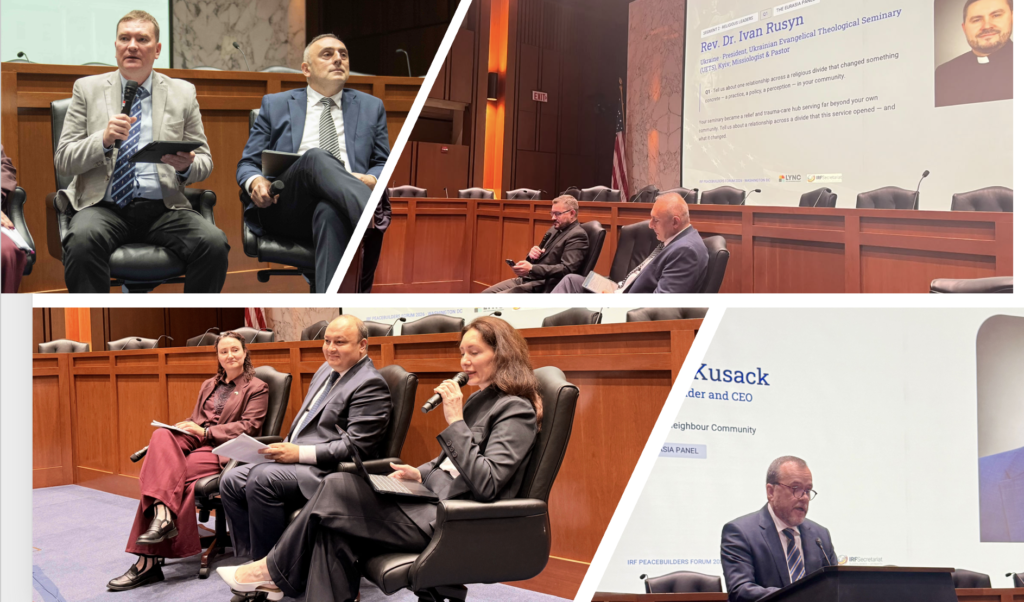
The 105-minute session was moderated by Wade Kusack and structured as three consecutive conversations—civil society, religious leaders, and academia—in which panelists from Ukraine, Kazakhstan, Georgia, and Uzbekistan answered shared questions in turn, with individually tailored sub-questions displayed on screen. The deliberate design, comparing how different post-Soviet societies answer the same question, produced precisely what the Panel was built for: a peer-to-peer exchange in which the countries of the region addressed one another rather than a Western audience.
Opening remarks were delivered by Ambassador Robert Rehak (Czech Republic) and the Hon. Geoff Davis, former Member of the U.S. Congress. The moderator opened with a personal account of his own immigration to the United States and the discovery, as someone born in the Soviet Union, of what freedom is and is not—framing the Panel as the professional continuation of that discovery: an instrument for learning freedom together, across the space where he was born. In an unannounced high-level appearance, Dr. Muzaffar Kamilov, Advisor to the President of the Republic of Uzbekistan and the senior government official overseeing religious affairs, came to honor and support the Eurasia Panel.
Panelists: Dr. Tetiana Kalenychenko (Ukraine; Dialogue in Action), Alexey Kildishov (Kazakhstan; lawyer and religious freedom expert), Guram Imerlishvili (Georgia; European Alliance for Religious Freedom), Rev. Dr. Ivan Rusyn (Ukraine; President, Ukrainian Evangelical Theological Seminary), Dr. Yuliya Kharkova (Kazakhstan; Scientific Institute of Public Law; Caspian University Scientific Advisory Board), and Dr. Olim Astanakulov (Uzbekistan; Vice Rector, International Islamic Academy of Uzbekistan). Quotations below are drawn from the session transcript, lightly edited for clarity.
- Evidence from Civil Society: Naming the Legacy, Practicing the Alternative
The civil-society conversation went directly to the Panel’s founding diagnosis. Asked about the greatest obstacle to social cohesion, Guram Imerlishvili named it without euphemism:
“The greatest obstacle in Georgia is an inherited mistrust—because the Soviet Union was trying to convince us that we cannot trust each other. People got to know each other through stereotypes rather than through relationships… and where there is distance, fear grows. We discovered that the opposite of mistrust is not agreement—it is relationships.” — Guram Imerlishvili
Dr. Tetiana Kalenychenko contrasted Ukraine’s trajectory with what she witnessed studying peacebuilding in the Balkans, where broken windows remained unrepaired for twenty-five years because citizens still assumed the government would act for them—a living image of learned passivity. Ukraine, she argued, has overcome the passivity but faces the deeper task:
“I’m coming from Bucha, and we restored all the windows. But we still struggle with the question… we learned how to survive, at least for now, but we don’t know how to live after the end of the war, in peace.” — Dr. Tetiana Kalenychenko
Her prescription—“agonistic peacebuilding,” in which actors agree to disagree but commit to joint action—describes the Panel’s own method: “If we can do something together, that is social cohesion… before making something, you just need to think who is around and how we can do it together.” Alexey Kildishov brought the legal dimension, analyzing Kazakhstan’s new Constitution (in force July 1, 2026) and arguing that rights on paper become real only through legal culture: restrictions on fundamental rights “must be necessary and proportional,” and “the freedom of religion depends not only on law—it also depends on legal culture, dialogue, and the ability of religious communities to be constructive partners with the state and society.” He reported that Kazakhstan’s multi-faith club—a direct fruit of this work—has been invited to contribute expertise to the parliamentary working group on post-constitutional religious legislation: civil society moving from the margins into the lawmaking process.
On trust, the panelists converged from three directions on one answer: trust is built by doing, not declaring. Kalenychenko described simulation role-plays in which bishops, imams, and pastors inhabit one another’s dilemmas, and the “Health in Action” alumni network whose evacuation chains in 2022 ran from Protestant churches through mosques to Orthodox routes—“trust channels” built years before the crisis that tested them. Imerlishvili distilled the practice:
“Trust begins when people stop preparing their answers and start listening to one another. People rarely remember every argument, but they always remember how they were treated in the meeting. Respect opens doors that arguments never can.” — Guram Imerlishvili
Asked what their countries offer one another, the exchange became the Panel in miniature: Ukraine offered field-tested emergency protocols, dialogue methodologies, and hard-won expertise in context-sensitive, do-no-harm programming; Kazakhstan offered a millennium-deep tradition of multi-faith hospitality and the lessons of its legal transformation; Georgia offered the lived proof of a small country where, within a few blocks of central Tbilisi, mosque, synagogue, and churches stand side by side—asking not for “another platform for positive reports,” but for partners who “show the locals around us and our government that we are not alone.”
- Evidence from Religious Leaders: Theology Under Fire, Dignity in Practice
The religious-leaders conversation produced the session’s most profound moments. Rev. Dr. Ivan Rusyn described how war inverted the relationship between doctrine and life:
“Before the war, we had an almost perfect theology. We polished it in our quiet offices, in our libraries, and we had answers for all questions. But war provoked a different set of questions… We discovered that authentic theology is not born among books, but in the midst of suffering. God does not observe suffering from a safe distance. He comes to the epicenter of suffering—and what is very radical, he calls us to follow him.” — Rev. Dr. Ivan Rusyn
His seminary’s campus was struck by six missiles; it now feeds thousands and shelters refugees it calls “unfamiliar neighbors,” served without regard to their beliefs and in a manner deliberately designed to protect their dignity—shared tables, shared meals, “special guests.” Out of this practice, he reported, is emerging a “theology of embrace,” and institutional change to match: the Ukrainian government has recognized churches as critically important infrastructure, has recognized theological education, and UETS will offer the first PhD program in public theology in Ukraine’s history—aimed at developing a “theology of citizenship” for a wounded society that “needs shepherds, not superstars.”
Imerlishvili, speaking as one who has belonged to both Georgia’s Orthodox majority and its evangelical minority, located the roots of extremism where the Panel’s prevention work aims: “Extremism begins with fear, isolation, ignorance, and the absence of meaningful relationships. This is where we need to invest.” His investment priority is education—curricula, books, and materials that make each community “recognizable” to its neighbors—grounded in a conviction that answers religious insecurity at its core:
“If you really believe that what you believe is truth, you are not afraid to listen to others.” — Guram Imerlishvili
Rusyn’s investment answer complemented it: helping churches become “communities of healing and restoration,” and giving society “a new narrative that remembers our painful past but does not keep us hostages of the past.” Between them, the two leaders articulated the Panel’s prevention thesis from inside religious communities themselves—precisely where prevention is most credible.
- Evidence from Academia: A Method That Travels, Institutions That Last
The academic conversation supplied the evidence and the architecture. Dr. Yuliya Kharkova reported on the LYNC–Caspian University CCRL program: since 2023, a Kazakhstan-specific methodology, curriculum, and materials, tested through three trainings in three cities with law enforcement, prosecutors, and the Committee for Religious Affairs—deliberately case-based rather than lecture-based, and multi-perspectival, with international experts, U.S. law-enforcement practitioners, an American imam, local lawyers, historians, and religious communities examining the same dilemmas together. The observed shift is the Panel’s core metric:
“Participants began to question the automatic assumption that a religious community is primarily a risk or an object of control. They increasingly saw religious actors as potential partners in preventing conflicts and maintaining social stability.” — Dr. Yuliya Kharkova
Her transfer finding defines how the Panel scales: “What transfers across countries is the methodology—facilitated dialogue, reflection on professional decisions, interdisciplinary teaching, continuous evaluation. What cannot simply be copied is the content… The methodology can travel; its legitimacy and practical meaning must be created locally.” Her institutional next step is concrete: a certified 72-hour training-of-trainers course, embedded in existing professional-development tracks of state agencies and the law-enforcement academy, building an internal national pool of trainers so that CCRL “can be reproduced, adopted, and developed within the system”—a shift, in her words, “from a logic of control to a logic of trust, prevention, and professional dialogue.”
Dr. Olim Astanakulov presented Uzbekistan’s complementary model—education as “intellectual immunity” against extremism: research centers devoted to the great scholars of Uzbekistan’s Islamic heritage (Imam Bukhari, Imam Termezi), media-literacy instruction in schools, and more than one thousand educational videos countering extremist messaging online—“using digital education to fight digital extremism.” The approach earned the UN World Interfaith Harmony Week first prize in 2025. “The best way to prevent extremism,” he concluded, “is not to isolate or force. It is education.”
Dr. Kalenychenko, speaking as researcher, gave the pedagogy its evidence base: classical contact theory—gather people in a hall and expect magic—does not work; “long contact in action” does. Her illustration became one of the session’s defining images: senior clergy of divided traditions, in sports suits, spending a full day together renovating a missile-damaged house near the Donetsk frontline—“they shared meals and work for twenty-four hours… on the next day they were ready to step into dialogue and to see each other not as official churches, but as human beings.”
- Institutional Commitments
The session generated substantive commitments that convert dialogue into institution—the Panel’s stated purpose. Ambassador Rehak formally proposed Prague as the standing meeting place of the Panel: “between East and West… a place of meeting and exchange of experience.” His framing reversed the customary direction of assistance and captured the Panel’s peer-to-peer ethos:
“It is not that the Eurasia countries need the help of the West. I see the great potential there that can help the other countries in the West that are in a desperate situation of heavy polarization… We can learn a lot from you.” — Amb. Robert Rehak
Dr. Astanakulov, on behalf of the International Islamic Academy of Uzbekistan, invited the Panel to hold a future international religious freedom forum in Tashkent, hosted at the Academy, and proposed a joint working group to prepare a one-to-two-year roadmap for research cooperation, academic exchange, and joint educational projects. Dr. Kamilov’s presence—the Advisor to the President of Uzbekistan, who came to honor and support the Eurasia Panel—signaled government endorsement at the highest level and stands in direct line with the recommendations of LYNC’s 2024 religious freedom assessment of Uzbekistan.
These international openings stand alongside the national commitments already documented in the evidence sections above — Kazakhstan’s certified training-of-trainers course and its multi-faith club’s entry into the parliamentary working group on religious legislation; Ukraine’s doctorate in public theology and its offer of field-tested crisis and dialogue methodologies to the region; Georgia’s curriculum development — with relationships further institutionalized through the IRF Secretariat office and the November conferences in Tbilisi and Prague. Hon. Geoff Davis, drawing on five decades of military and congressional service and on the 2013 Istanbul dialogue that redirected his public life, gave the model its strategic endorsement: “This approach is the first thing… that I have seen that prevents conflict, that proactively builds the future… If we are patient, these principles work like physics.”
- Lessons Learned
Measured against its founding purpose, the inaugural session did more than discuss the Panel’s method—it performed it. The Soviet legacy was named explicitly and repeatedly, not by outside critics but by the region’s own leaders: inherited mistrust (Imerlishvili), learned passivity (Kalenychenko), the reflex of control (Kharkova), the underground religious education and thin legal culture left behind (Kildishov), and the Soviet-era practice of hiding the vulnerable that Ukraine’s emerging “theology of disability” now answers (Rusyn). Against each inherited pattern, a panelist set a practiced alternative—relationships against mistrust, joint action against passivity, partnership against control, education against fear—each grounded in documented national experience and each transferable through the CCRL methodology that Kharkova’s research shows travels well when content is rebuilt locally.
Beyond that mapping, the session yielded four implementation lessons for the Panel’s next phase. First, peer learning generated greater openness than country-by-country presentation: panelists addressed one another as colleagues confronting a shared inheritance, and the most candid diagnoses—inherited mistrust, the reflex of control—were volunteered, not extracted. Second, cross-sector dialogue surfaced common patterns that no single sector could see alone: the same legacy named by a Georgian civil-society leader appeared in the attitudes of Kazakhstani officials before CCRL training and in the learned passivity Ukraine’s peacebuilders work against—confirming that the Soviet legacy is a region-wide, cross-sector phenomenon requiring a region-wide, cross-sector response. Third, methodology transferred more readily than policy prescriptions: what panelists asked of one another was not model legislation but methods—facilitated dialogue, case-based training, joint action—validating the Panel’s decision to scale CCRL as a method while content is rebuilt locally. Fourth, institutional partnerships emerged most readily from practical cooperation rather than normative debate: each of the commitments recorded in Section 6 grew out of concrete joint work, not declarations—evidence that the Panel’s engage–research–equip sequence orders activities correctly.
The inaugural format also highlighted areas for refinement. Session time proved the binding constraint: even with a disciplined comparative format, one planned academic question had to be dropped on stage to protect the closing segment, confirming that deeper country-to-country exchange requires more than a single public session—future convenings will pair the public panel with closed working sessions for collaborative problem-solving and joint planning, as was piloted at the July 18 founders’ session. Participation also remained uneven: Moldova’s consultant membership was not represented on stage, several confirmed panelists were unable to travel, and the religious-leaders segment ultimately drew from a narrower range of traditions than the Panel’s membership holds. Broadening on-stage representation—across countries, and across the region’s Muslim, Orthodox, and other communities—is a stated priority for the Panel’s first operational year.
- Next Steps
The standing the session revealed — recorded in the evidence and commitments above — gives the next phase its momentum, as does the spirit in which panelists addressed one another: colleagues in a shared project rather than case studies for a Western audience. The task ahead — institutionalization through the charter process, the Prague ministerial in November 2026, and the first year of Panel operations — is to convert those commitments into the standing structures the session called for. The inaugural session gives that work a strong foundation and, in the words spoken from its stage, a clear direction: from the logic of control to the logic of trust.
The inaugural session validated the implementation model; the next phase will test its sustainability through the evaluation framework already in place. Success will be measured against the Panel’s evaluation framework of two evaluation points per objective, combining output documentation and indicators of external recognition in international convenings. Implementation of the commitments recorded in this report will be verified through the same instruments: documented consultation cycles in each member country, rapporteur reports from the delegation’s working sessions, executed country-lead agreements, and a published first annual statement—against which each commitment recorded in this report can be tracked. The principal risks to adoption—uneven absorption across national systems, dependence on a small pool of individual experts until the training-of-trainers cohort matures, and the region’s geopolitical volatility—are addressed by design: Duty of Care governs all country engagement, and CCRL is being embedded within national institutions precisely so that progress does not rest on any single program, person, or meeting.